Building a Lean Business Model
In today's fast-paced business landscape, operational efficiency is crucial for startups and growing businesses to stay competitive.
Adopting a lean business model enables companies to streamline their operations, eliminate waste, and drive growth. By focusing on efficiency and reducing unnecessary costs, businesses can allocate more resources to innovation and customer satisfaction.
This approach not only enhances a company's agility but also improves its bottom line. As a result, businesses can respond more effectively to changing market conditions and customer needs.
Key Takeaways
- Streamlining operations is crucial for business growth.
- A lean business model helps eliminate waste and reduce costs.
- Operational efficiency enables businesses to allocate more resources to innovation.
- A lean approach enhances a company's agility and responsiveness.
- Improved operational efficiency leads to a better bottom line.
The Fundamentals of a Lean Business Model
Lean methodology has become a cornerstone for businesses aiming to maximize efficiency and minimize waste. At its core, the lean approach is about creating value for customers while eliminating unnecessary processes.
Defining the Lean Approach to Business
The lean approach to business is centered around understanding customer needs and delivering value through a streamlined product development process. This involves continuous iteration and improvement based on customer feedback.
Origins and Evolution of Lean Methodology
Originally developed in the manufacturing sector, lean methodology has its roots in the Toyota Production System. Over time, it has evolved and been adapted for various industries, including software development and startups. Key principles include:
- Eliminating waste
- Optimizing workflows
- Fostering a culture of continuous improvement
Why Traditional Business Models Often Fail
Traditional business models often fail because they are rigid and not customer-centric. They typically involve significant upfront planning and investment, which can lead to business model failure if the market dynamics change. In contrast, the lean approach allows for flexibility and quick adaptation to changing customer needs.
By adopting a lean business model, companies can avoid the pitfalls of traditional models and focus on delivering value to their customers efficiently.
Core Principles of the Lean Startup
The lean startup methodology is built around several core principles that enable startups to navigate uncertainty and achieve success. These principles are designed to foster a culture of innovation, efficiency, and continuous improvement.
Build-Measure-Learn Feedback Loop
The Build-Measure-Learn loop is a fundamental component of the lean startup approach. It involves building a product or feature, measuring its success, and learning from the data to inform future development. This cycle is repeated continuously to ensure that the startup remains on a path towards creating a product that meets customer needs.
Implementing the Build-Measure-Learn loop effectively requires a willingness to experiment and adapt. Startups must be prepared to pivot based on the insights gained from this process.
https://www.youtube.com/watch?v=xkaabHiZN-k
Validated Learning
Validated learning is about ensuring that the lessons drawn from the Build-Measure-Learn loop are based on actual customer feedback and data, rather than assumptions. This principle emphasizes the importance of engaging with customers and understanding their needs to guide product development.
"The goal is not to build something that will make money in the long run, but to build something that people will buy now." - Eric Ries
Minimum Viable Product (MVP)
The Minimum Viable Product is a product development strategy that involves releasing a product with just enough features to satisfy early customers and provide feedback for future development. The MVP is a key tool in the lean startup arsenal, allowing startups to test hypotheses and gather data with minimal resources.
Innovation Accounting
Innovation accounting is a method for measuring the progress of startups in a way that is relevant to their innovative activities. It involves tracking metrics that matter, such as customer acquisition costs and retention rates, to assess the effectiveness of the startup's strategies.
| PrincipleDescriptionKey Benefit | ||
| Build-Measure-Learn | A cyclical process of building, measuring, and learning. | Continuous improvement and adaptation. |
| Validated Learning | Learning based on actual customer feedback. | Ensures product-market fit. |
| Minimum Viable Product (MVP) | Releasing a product with minimal features. | Reduces product development risk. |
| Innovation Accounting | Tracking metrics relevant to innovation. | Provides a clear picture of progress. |
By embracing these core principles, lean startups can navigate the challenges of entrepreneurship with greater agility and resilience.
Benefits of Implementing a Lean Business Model
A lean business model is designed to maximize value while minimizing waste, leading to improved adaptability and customer focus. By adopting lean principles, startups can significantly enhance their operational efficiency and competitiveness.
Reduced Waste and Operational Costs
One of the primary benefits of a lean business model is the reduction of waste and operational costs. By streamlining processes and eliminating non-value-added activities, startups can achieve significant cost savings. This is achieved through efficient resource allocation and continuous improvement practices.
Faster Time to Market
Lean businesses focus on developing products and services that meet customer needs quickly. By adopting agile development methodologies and rapid prototyping, startups can reduce their time to market, gaining a competitive edge.
Enhanced Customer Focus
A lean business model emphasizes understanding and meeting customer needs. Through customer feedback loops and validated learning, startups can ensure that their products or services are closely aligned with customer expectations, enhancing customer satisfaction and loyalty.
Improved Adaptability to Market Changes
Lean startups are more adaptable to market changes due to their flexible business models and iterative development processes. This enables them to pivot quickly in response to new information or changing market conditions.
| BenefitDescriptionImpact | ||
| Reduced Waste | Elimination of non-value-added activities | Cost Savings |
| Faster Time to Market | Agile development and rapid prototyping | Competitive Advantage |
| Enhanced Customer Focus | Customer feedback and validated learning | Increased Customer Satisfaction |
| Improved Adaptability | Flexible business models and iterative development | Market Responsiveness |
Identifying Your Value Proposition in a Lean Framework
Lean startups thrive by delivering value propositions that resonate with their target audience. A well-crafted value proposition is essential for differentiating your product or service in a crowded market.
Customer Problem Discovery
Understanding customer needs is pivotal. This involves problem interviews and observation techniques to gain insights into customer pain points.
Problem Interviews
Conducting problem interviews helps in understanding the challenges your customers face. It's about listening to their needs and identifying areas where your solution can make a significant impact.
Observation Techniques
Observation techniques involve watching how customers interact with your product or service. This can reveal unmet needs and opportunities for innovation.
Solution Validation Techniques
Once you've identified potential solutions, it's crucial to validate them with your target audience. This can be done through prototyping and A/B testing, ensuring that your solution meets customer needs effectively.
Creating a Compelling Value Proposition Canvas
A Value Proposition Canvas is a strategic tool that helps you visualize, design, and innovate your value proposition. It ensures that your product or service addresses the needs and wants of your customers.
| ComponentDescriptionExample | ||
| Customer Jobs | Tasks customers are trying to accomplish | Booking a hotel room online |
| Pains | Challenges customers face | Difficulty finding reliable reviews |
| Gains | Benefits customers are seeking | Getting the best price guarantee |
| Products/Services | Offerings that address customer needs | Hotel comparison website |
| Pain Relievers | How your solution alleviates pains | Verified customer reviews |
| Gain Creators | How your solution creates gains | Price match guarantee |
Developing Your Minimum Viable Product
Developing an MVP is a strategic approach to testing your product idea with minimal resources. This process allows startups to validate their product hypotheses with real users, gather feedback, and iterate towards a more refined product.
Defining Essential Features vs. Nice-to-Haves
When developing your MVP, it's crucial to distinguish between essential features and those that are merely nice-to-have. Essential features are those that directly address the core problem your product aims to solve. By focusing on these key features, you can create a functional MVP that resonates with your target audience.
Prototyping Strategies for Quick Validation
Prototyping is a vital step in the MVP development process. It involves creating a preliminary version of your product to test assumptions and gather feedback. Effective prototyping strategies include using low-fidelity prototypes to visualize your product's core features and iterating based on user feedback.
Testing Your MVP with Early Adopters
Once your MVP is ready, the next step is to test it with early adopters. This group of users is typically more forgiving and open to new products, providing valuable insights into your product's strengths and weaknesses.
Gathering Meaningful Feedback
Gathering feedback from early adopters is crucial for refining your product. It's essential to ask the right questions and listen actively to their responses. This feedback loop helps you understand whether your product meets user needs and where improvements are necessary.
Implementing Rapid Iterations
After gathering feedback, the next step is to implement rapid iterations. This involves making targeted changes to your product based on user feedback, testing new features, and continuously refining your MVP until it meets market demands.
By following these steps, startups can effectively develop their MVP, validate their product with real users, and iterate towards a successful product-market fit.
Customer Development in the Lean Startup Process
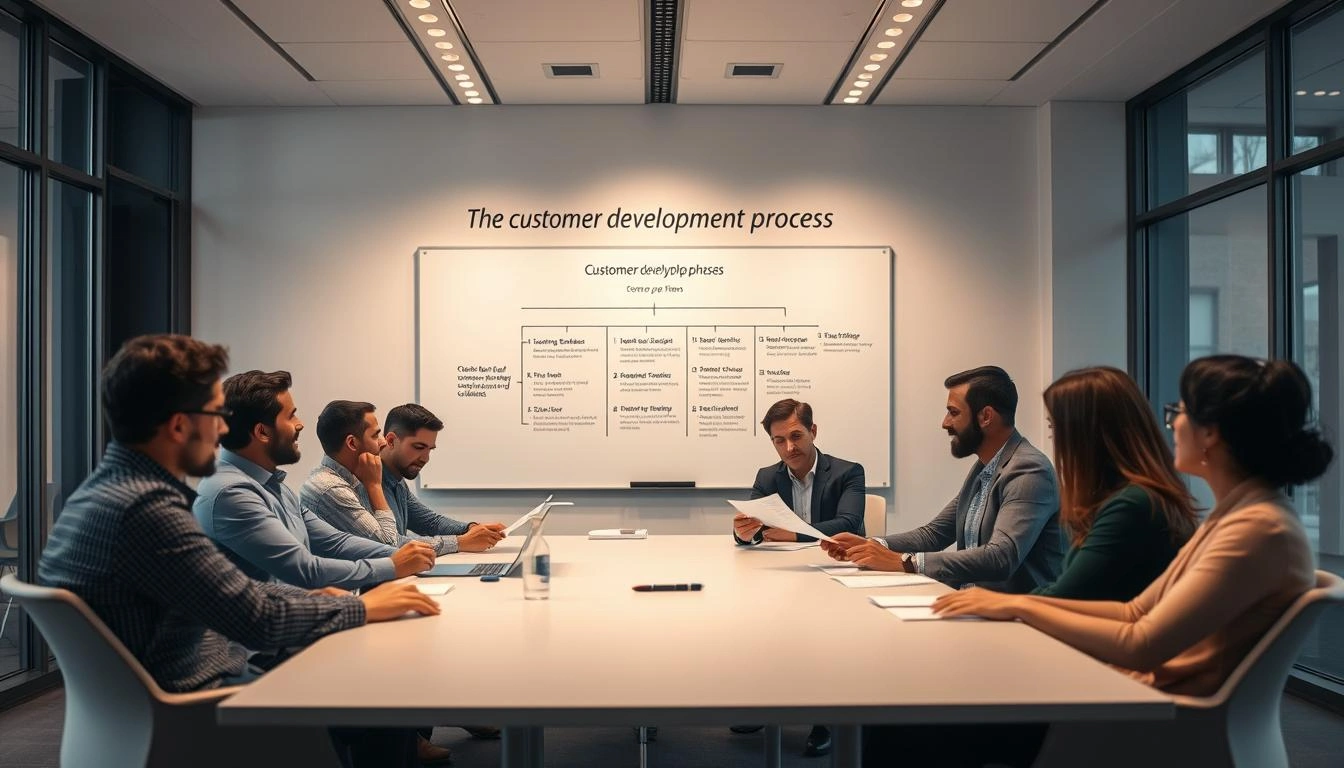
Customer development is a critical component of the lean startup process. It involves understanding your target market, gathering insights through customer interviews, and creating personas to guide your product development.
Understanding Your Target Market
Understanding your target market is the first step in customer development. It requires identifying the demographics, needs, and pain points of your potential customers. As Steve Blank, a pioneer in the lean startup movement, once said,
"The biggest risk is not that you're wrong, it's that you're not learning."
This emphasizes the importance of continuous learning about your target market.
Customer Interview Techniques
Conducting effective customer interviews is crucial for gathering insights. It's essential to ask open-ended questions that encourage honest feedback. Active listening is key to understanding the needs and concerns of your customers.
Building Customer Personas
Once you've gathered enough data from customer interviews, you can start building customer personas. These personas are fictional representations of your ideal customers and help guide your product development and marketing strategies.
Pivoting Based on Customer Insights
Pivoting is a fundamental aspect of the lean startup methodology. It involves making strategic changes to your product or service based on customer feedback. Knowing when to pivot is crucial, and it requires a deep understanding of your customers' needs.
When to Pivot vs. When to Persevere
Deciding whether to pivot or persevere can be challenging. It involves analyzing customer feedback, market trends, and your product's performance. As Eric Ries notes,
"The goal is not to be right, but to be successful."
This mindset is essential when considering a pivot.
Types of Pivots in Lean Startups
There are several types of pivots that lean startups can consider, including customer segment pivot, business model pivot, and product feature pivot. Each type of pivot requires a different strategy and understanding of customer needs.
Financial Aspects of a Lean Business Model
Financial management is at the core of a successful lean business model, enabling startups to navigate challenges effectively. A lean approach to finance involves making the most of limited resources, optimizing cash flow, and ensuring that every dollar spent contributes to the business's growth and sustainability.
Bootstrapping vs. External Funding
One of the critical decisions lean startups face is whether to bootstrap or seek external funding. Bootstrapping allows businesses to maintain control and equity, relying on personal savings or revenue to fund operations. On the other hand, external funding can provide the necessary capital for rapid growth, but it often comes with the cost of equity and potential loss of control.
Optimizing Burn Rate
Managing the burn rate is crucial for lean startups, as it determines how long the business can operate before needing additional funding. Strategies to optimize burn rate include reducing operational costs, streamlining processes, and focusing on high-return activities.
Revenue Models for Lean Startups
Lean startups need revenue models that are flexible and scalable. Common models include subscription-based services, freemium models, and transactional sales. The key is to find a model that aligns with the target market's needs and preferences.
Key Financial Metrics to Track
To ensure financial health, lean startups must track several key metrics:
- Customer Acquisition Cost (CAC): The cost of acquiring a new customer.
- Lifetime Value (LTV): The total value a customer brings to the business over their lifetime.
- Runway: The amount of time the business can operate with its current funding.
- Break-Even Analysis: The point at which the business's revenue equals its total fixed and variable costs.
Customer Acquisition Cost (CAC)
Understanding CAC is vital to determining the efficiency of marketing strategies and ensuring that the cost of acquiring customers does not outweigh the revenue they generate.
Lifetime Value (LTV)
LTV helps businesses understand the long-term value of their customers, enabling them to make informed decisions about customer retention and acquisition strategies.
Runway and Break-Even Analysis
Knowing the runway and performing break-even analysis are critical for planning and ensuring the financial sustainability of the business.
Tools and Techniques for Implementing Lean Startup Methodology
Implementing lean startup methodology requires a combination of the right lean tools and techniques. These tools help startups iterate quickly, measure progress, and make informed decisions.

Lean Canvas vs. Business Model Canvas
The Lean Canvas and Business Model Canvas are both strategic management tools. The Lean Canvas is specifically designed for startups, focusing on problems, solutions, and key metrics. In contrast, the Business Model Canvas is more geared towards established businesses. Understanding the differences between these two can help startups choose the most appropriate tool for their needs.
A/B Testing Frameworks
A/B testing is crucial for validating assumptions about customer behavior. By comparing two versions of a product or feature, startups can determine which performs better. This technique is essential for making data-driven decisions and improving product-market fit.
Agile Development Methodologies
Agile development methodologies emphasize flexibility, collaboration, and rapid iteration. By adopting agile practices, startups can quickly respond to changing customer needs and market conditions.
Customer Feedback Systems
Effective customer feedback systems are vital for understanding customer needs and preferences. These systems include various tools such as:
Survey Tools
Survey tools like SurveyMonkey and Google Forms help gather direct feedback from customers.
Analytics Platforms
Analytics platforms such as Google Analytics provide insights into customer behavior and product performance.
User Testing Software
User testing software like UserTesting enables startups to observe how real users interact with their products, identifying areas for improvement.
By leveraging these lean tools and techniques, startups can enhance their ability to iterate, measure, and learn, ultimately achieving a more successful product-market fit.
Overcoming Common Challenges in Lean Implementation
As startups embark on the lean journey, they often face significant hurdles that can impact their growth. Implementing lean principles is not just about adopting a new methodology; it's about transforming the organizational culture and mindset.
Resistance to Change
One of the primary challenges is resistance to change. Employees and stakeholders may be accustomed to traditional methods and may resist the shift towards a lean approach. To overcome this, it's crucial to communicate the benefits of lean clearly and involve the team in the transition process.
Balancing Speed with Quality
Startups often struggle with balancing speed and quality. While speed is essential for getting to market quickly, compromising on quality can be detrimental. Implementing agile methodologies can help achieve this balance by allowing for rapid iteration while maintaining high standards.
Avoiding Analysis Paralysis
Analysis paralysis is another common pitfall. Startups may get caught up in endless planning and analysis, delaying action. To avoid this, setting clear milestones and deadlines can help maintain momentum.
Managing Investor Expectations
Managing investor expectations is also critical. Investors may have different priorities, such as rapid growth or immediate returns. Clear communication and setting realistic goals can help align expectations.
Maintaining Team Morale During Pivots
Pivoting is a common aspect of the lean startup methodology, but it can be challenging for teams. Maintaining team morale during these times is crucial. Leaders should foster a culture that views pivots as learning opportunities rather than failures.
By understanding and addressing these challenges, startups can more effectively implement lean principles and achieve their goals.
Conclusion: Embracing the Lean Mindset for Long-Term Success
Embracing a lean mindset is crucial for startups aiming to achieve long-term success. By adopting lean principles, businesses can foster a culture of continuous innovation and improvement, driving growth and sustainability.
The lean startup culture encourages experimentation, validated learning, and customer-centric approaches. By integrating these elements, startups can navigate complex markets and stay adaptable in the face of change.
To achieve long-term success, it's essential to embed lean principles into the organizational culture. This involves promoting a mindset that values efficiency, innovation, and customer satisfaction. By doing so, businesses can create a competitive edge and ensure their continued relevance in an ever-evolving market landscape.
By adopting a lean mindset, startups can position themselves for sustained growth and success, ultimately leading to a more resilient and adaptable business model.
FAQ
What is a lean business model?
A lean business model is an approach to building and managing a business that focuses on minimizing waste, maximizing value, and achieving rapid growth through continuous iteration and improvement.
How does the build-measure-learn feedback loop work?
The build-measure-learn feedback loop is a core principle of the lean startup methodology, where you build a minimum viable product, measure its success, and learn from the data to inform your next steps.
What is a minimum viable product (MVP)?
A minimum viable product is a product or service that has just enough features to satisfy early customers and provide feedback for future development.
How do I identify my value proposition in a lean framework?
To identify your value proposition, you need to understand your customers' problems, validate your solution, and create a compelling value proposition canvas that communicates your unique selling proposition.
What are some common challenges in implementing lean startup methodology?
Common challenges include resistance to change, balancing speed with quality, avoiding analysis paralysis, managing investor expectations, and maintaining team morale during pivots.
What tools can I use to implement lean startup methodology?
Some useful tools include the lean canvas, A/B testing frameworks, agile development methodologies, customer feedback systems, survey tools, analytics platforms, and user testing software.
How do I manage my burn rate as a lean startup?
To manage your burn rate, you need to optimize your expenses, prioritize your spending, and ensure that you have a clear understanding of your financial metrics, such as customer acquisition cost and lifetime value.
What is innovation accounting?
Innovation accounting is a method of measuring progress and success in a lean startup, by tracking key metrics such as revenue growth, customer acquisition, and retention.
How do I know when to pivot or persevere?
To decide whether to pivot or persevere, you need to analyze your customer feedback, assess your progress, and make data-driven decisions to inform your next steps.
About the Author
Micheal is a dedicated writer with a passion for crafting engaging, thoughtful, and impactful content. With a keen eye for detail and a commitment to clarity, Micheal brings complex ideas to life in a way that is both accessible and inspiring. Whether writing informative articles, creative pieces, or persuasive copy, Micheal aims to connect with readers and leave a lasting impression.